


Mechanical

Plug: type your hole diameter, get a flanged cap

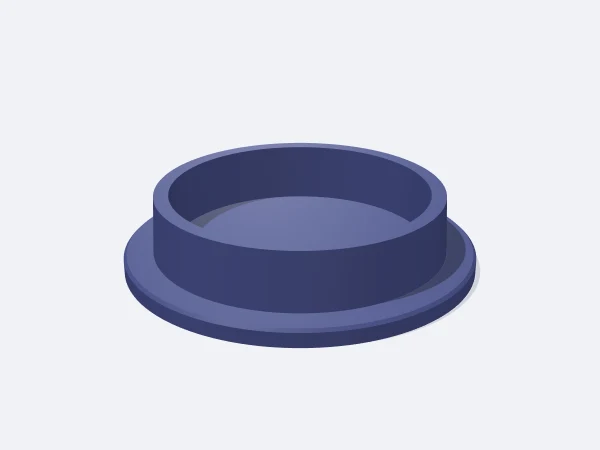
This page opens the DrawSTL plug template: a parametric flanged plug for pipe ends, desk holes and tube profiles, sized in millimetres and downloaded as a print-ready STL. The plug diameter is the body that enters the hole, and the flange diameter is the visible cap that rests on the surface around it.

The body tapers towards the tip, which lets the plug enter easily and wedge tighter as you push. The hollow option scoops the body out from the top to save material and time. The flange is always kept at least 2 mm larger than the plug.

Free, no sign-up. Change the sizes in millimetres and download the STL.

DrawSTL plug template: a plastic plug with a round flange resting on the hole edge and a body tapering towards the tip

Ready-made variants

Each variant is the same template with different settings. Follow the link and the editor opens with those values.

Adjustable sizes

These values are edited in the editor's template panel. A number outside the range is clamped to the nearest limit automatically.

SizeRangeDefault
Dimensions
Plug diameter3–80 mm15 mm
Plug length3–70 mm12 mm
Tip taper0–4 mm1 mm
Flange diameter5–100 mm35 mm
Flange thickness1–12 mm3.5 mm
Options
HollowOn / OffOff
Wall thickness *0.8–10 mm2 mm

Sizes marked with a star appear in the panel only when the related shape, style or option is active.

What it is used for

  • Capping pipe, tube and timber ends to keep dust out
  • Covering an unused cable hole in a desk or cabinet
  • Hiding furniture assembly holes and screw pockets
  • Replacing a lost factory plug or rubber bung
  • A protective cap for chair and table legs

Printing tips

Orientation
The flange sits flat on the bed and the body tapers upward. No rotation needed and every conical surface prints support free.
Layer height
0.2 mm. Use 0.16 mm when you want the top face of the flange to look smooth.
Infill
20% is enough for a solid body. With the hollow option, a 2-3 mm wall with 10% infill is the better combination.
Supports
None. The flange underside is on the bed and the taper runs upward.
Material
PETG is the best all-round pick for repeated insertion and impact. Use TPU for a leg cap or non-slip tip, and PLA where the plug stays put indoors.

Tips

  • Measure the hole with a caliper and set the plug diameter 0.2-0.3 mm under it. Go 0.5 mm under for a loose fit.
  • A taper around 1 mm gives easy entry and good grip in most holes.
  • Keep the flange at least 5 mm larger than the hole so it seats properly on the surrounding surface.

Sizing the plug to your hole

How well the plug grips depends entirely on the relation between plug diameter and hole diameter. Because the body narrows towards the tip, the plug enters easily and wedges as it goes deeper. That makes the plug diameter, the widest part near the flange, the number that has to be close to the hole size.

In practice, measuring the hole and entering 0.2 to 0.3 mm less gives a push-in, pull-out grip. In pipe bores, where inner diameters vary, start 0.3 mm under, measure the result and adjust once.

  • Hole size minus 0.2-0.3 mm: removable by hand
  • Equal to hole size: permanent, hard to pull out
  • Hole size minus 0.5-0.8 mm: loose, intended to be glued
  • Taper of 1-2 mm: easy entry with progressive wedging
When a hollow body makes sense

Above about 25 mm of plug diameter, a solid body burns noticeable material and time. The hollow option cuts the body out from the top and leaves a wall as thick as the value you set, opening upward with vertical walls so nothing needs support.

On small plugs under 15 mm there is no point in hollowing, and a very thin wall weakens the grip. On large desk hole covers, cut the top face of a hollow plug in the editor and you have a pass-through grommet.

Frequently asked questions

Should the plug diameter match the hole exactly?

Go 0.2-0.3 mm under for something you can remove by hand. Match the measurement when you want it permanent and let the plastic flex grip.

What is the flange for?

It is the visible cap that rests on the surface around the hole. It stops the plug falling in and hides the hole edge, and it is always at least 2 mm larger than the plug.

Does it work for square tube?

This template makes round plugs only. For square profile, build a similar plug from a box shape in the editor.

My plug came out loose, do I have to reprint?

For a small gap, one wrap of tape around the body is usually enough. For a proper fix, raise the plug diameter by 0.2 mm and reprint.

Similar templates

Set the sizes to fit your part

Open the template in the editor, enter your values and download a print-ready STL. No account needed.

Open in editor