

Mechanical

Spur gear: enter teeth and module, get a true involute profile

This page opens the DrawSTL spur gear template: a parametric cylindrical gear whose tooth flanks come from a real involute curve, sized in millimetres and downloaded as a print-ready STL. Type tooth count, module and thickness, and the pitch, root and tip diameters plus the flank geometry are calculated for you.

Pressure angle can be 20 or 14.5 degrees. You set the bore in millimetres, and adding a hub on one face runs the bore through it too, which lengthens shaft engagement and keeps the gear from rocking.

Free, no sign-up. Change the sizes in millimetres and download the STL.

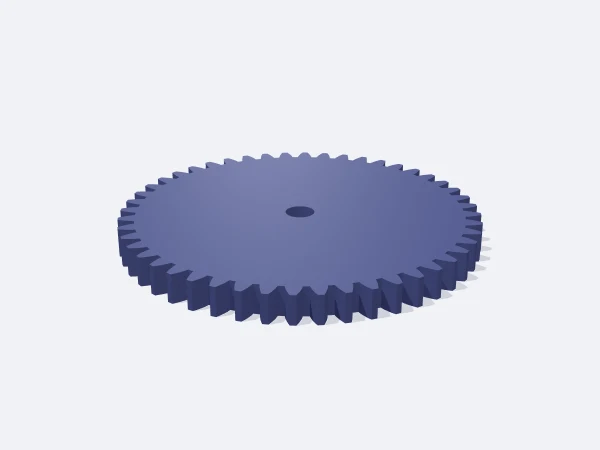
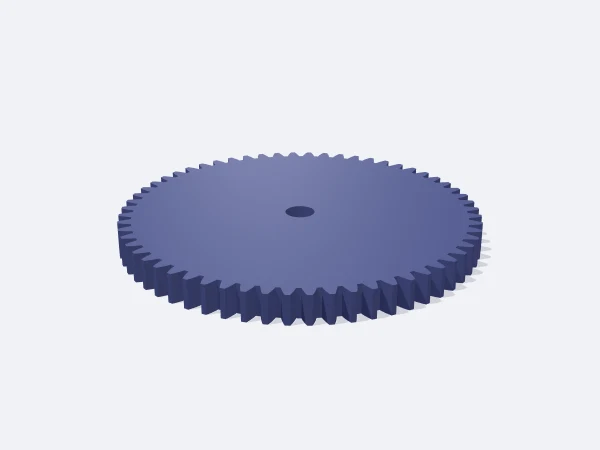
DrawSTL spur gear template: a 3D printable gear with involute teeth, a central bore and a hub on one face

Ready-made variants

Each variant is the same template with different settings. Follow the link and the editor opens with those values.

Adjustable sizes

These values are edited in the editor's template panel. A number outside the range is clamped to the nearest limit automatically.

SizeRangeDefault
Teeth8–12020
Module0.5–6 mm2 mm
Thickness1–100 mm8 mm
Pressure angle14.5°, 20°20°
Bore Ø0–100 mm5 mm
HubOn / OffOn
Hub Ø2–200 mm14 mm
Hub height0–50 mm5 mm

What it is used for

  • Replacing a broken gear in a toy, appliance or drawer mechanism
  • Gearbox and reduction experiments for homemade machines
  • Changing speed and torque on a small stepper or DC motor
  • Classroom models that show gear ratios physically
  • Kinetic sculpture, clock and automata mechanisms

Printing tips

Orientation
The gear lies flat on the bed with the axis vertical. Layers run perpendicular to the tooth flanks, which gives the most accurate profile.
Layer height
0.16-0.2 mm. Use 0.12 mm for module 1 and below, and 0.24 mm from module 3 upwards.
Infill
60% or more for load-bearing gears. Raising the wall count to 4 strengthens the tooth roots more than extra infill does.
Supports
None. Every surface, hub included, is vertical or flat.
Material
PETG is tougher than PLA and resists tooth-root cracking. For quiet, wear-resistant running use nylon or POM.

Tips

  • Over-extrusion thickens the teeth and tightens the mesh, so calibrate flow if you see bulges on the flanks.
  • Make the bore 0.1-0.2 mm oversize, or drill it to final size after printing.
  • Print a meshing pair with the same material and settings; mixed settings spoil the mesh.

Picking the module and tooth count

Module sets tooth size and tooth count sets diameter. Pitch diameter is simply module times tooth count, so module 2 with 20 teeth gives a 40 mm pitch circle, and the outside diameter is roughly two modules larger.

Two gears only mesh when module and pressure angle match. Their centre distance is module times (teeth1 + teeth2) divided by 2, so use that to pick a tooth pair that lands on the spacing your design needs.

  • Module 1-1.5: small, lightly loaded mechanisms, weak printed roots
  • Module 2: a balanced default for 3D printing
  • Module 3-4: motor outputs, hand cranks, loaded drives
  • Module 5-6: coarse teeth for slow, high-torque work
Pressure angle, hub and bore

A 20 degree pressure angle is standard: thicker tooth roots survive printing better. The older 14.5 degree option gives smoother, quieter contact but weakens the root at low tooth counts, so measure which one an existing gear uses before copying it.

The hub is a short cylinder on one face, and because the bore passes through it the shaft is gripped over a longer length. Hub diameter is kept inside the root circle and oversized values are clamped.

Frequently asked questions

Will two of these gears mesh?

Yes, as long as module and pressure angle match. Tooth counts may differ; compute centre distance as module x (teeth1 + teeth2) / 2.

What bore size should I enter?

Go 0.1-0.2 mm over the nominal shaft size. For a 5 mm shaft, 5.1-5.2 mm is a good start; drill it clean if it still binds.

Can I add a keyway to the bore?

The template has no keyway, the bore is round. Add the gear in the editor and subtract a small box shape to cut one yourself.

What is the lowest usable tooth count?

The template starts at 8 teeth, but at 20 degrees undercut begins below 17 teeth. For printed gears, 14 teeth and up behave more predictably.

Similar templates

Set the sizes to fit your part

Open the template in the editor, enter your values and download a print-ready STL. No account needed.

Open in editor