Home and desk

Generate a bird deterrent spike strip

This tool builds the bird deterrent spike strip that mounts on walls, sills and fences, sized by you and exported as an STL. Enter the strip length and width in millimetres, choose the spike type and height, and the model is computed in your browser.

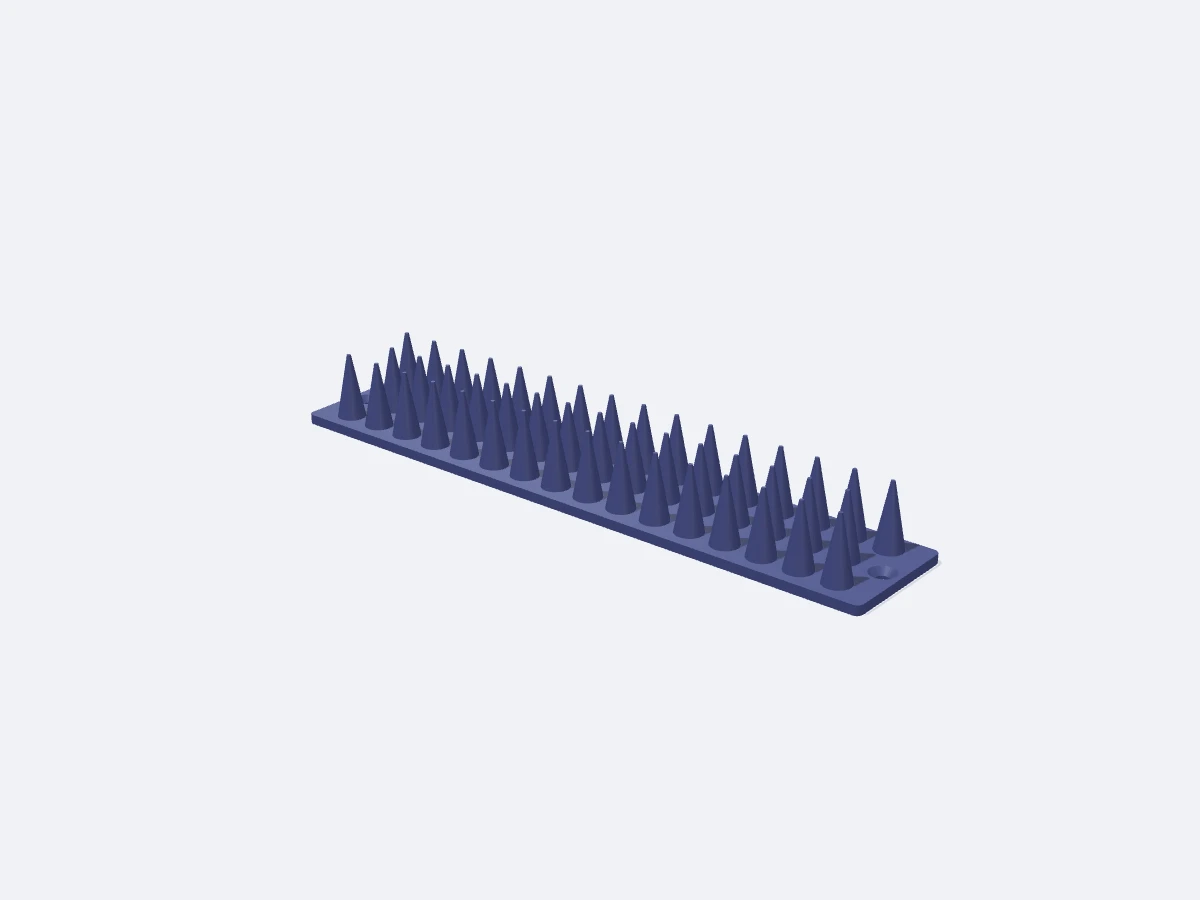
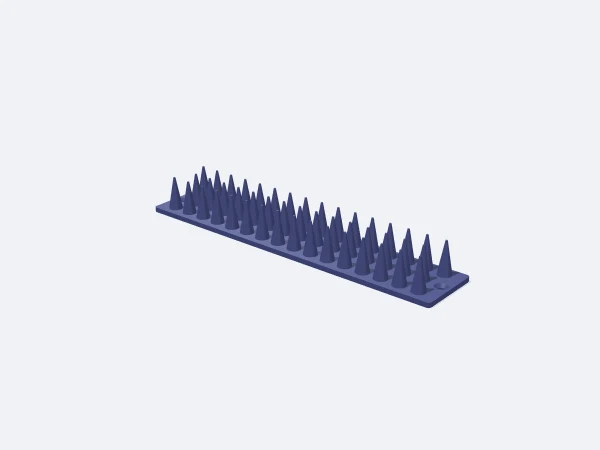
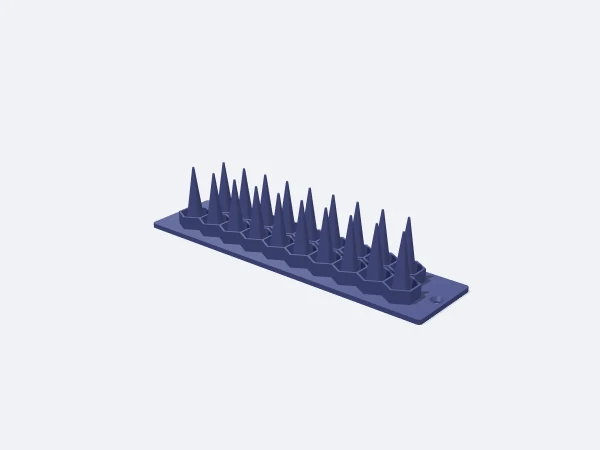
The strip is a honeycomb grid carrying staggered rows of pointed spikes. The aim is not to injure but to leave no flat surface to land on, which is why the spikes sit close together and offset row to row. The same template also makes wall caps against climbing cats and rodents.

Free, no sign-up. Change the sizes in millimetres and download the STL.

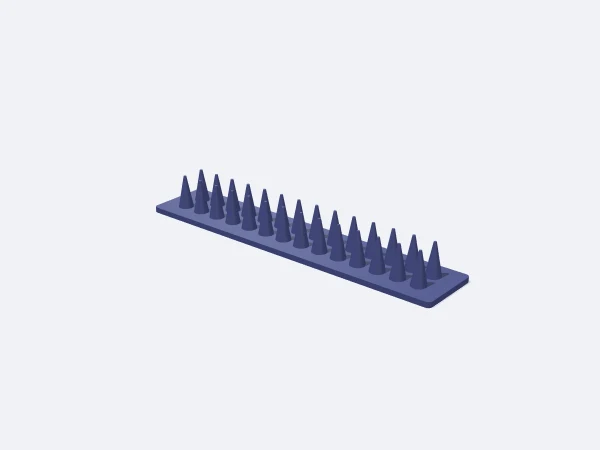
Pointed cone spikes in staggered rows on a long narrow base

Ready-made variants

Each variant is the same template with different settings. Follow the link and the editor opens with those values.

Adjustable sizes

These values are edited in the editor's template panel. A number outside the range is clamped to the nearest limit automatically.

SizeRangeDefault
Shape
MountingScrewed, AdhesiveScrewed
Spike typeCone, StarCone
Dimensions
Strip length40–400 mm200 mm
Strip width20–120 mm40 mm
Base thickness1.5–10 mm3 mm
Corner radius0–20 mm2 mm
Pattern
Honeycomb cell6–40 mm11 mm
Cell wall0.8–6 mm0.8 mm
Cell wall height0–30 mm0 mm
Row spacing0–25 mm2.3 mm
Style
Star arms *5–1610
Spike height5–90 mm20 mm
Spike base diameter2–20 mm20 mm
Tip bluntness0.8–6 mm1.2 mm
Mounting
Screw hole *2–10 mm4 mm

Sizes marked with a star appear in the panel only when the related shape, style or option is active.

What it is used for

  • Pigeon deterrent on balcony railings and window sills
  • Climbing deterrent along fences and garden walls
  • Bird guard on air conditioning units and flue caps
  • Preventing nesting along a roof gutter edge

Printing tips

Orientation
Print base down with the spikes up. Cone spikes are inherently support free, and star arms open at most 45° from vertical while staying inside their own cell.
Layer height
0.2 mm. With a tip around 1.2 mm, a thinner layer sharpens the point further.
Infill
25% infill with 3 perimeters. The spikes print solid anyway, so infill mostly lands in the base plate.
Supports
None needed. Both cone and star spikes are limited to print without support.
Material
Use ASA or another UV-stable material, since the strip lives outdoors in full sun. PETG is a reasonable second choice for a season or two. PLA turns brittle within months and the tips snap off, so avoid it outdoors.

Tips

  • Keep the tip at 1.2 mm or more with a 0.4 mm nozzle; thinner tips are a single line and break on first contact.
  • The spike base must fit its cell: the panel limits it to 80% of the cell and reports the new value.

Cone or star, and what the cell does

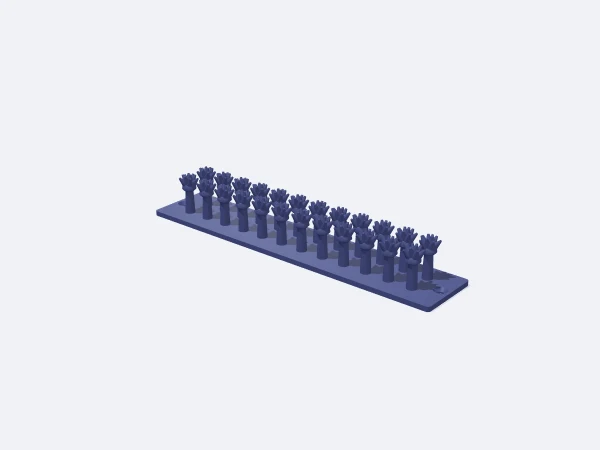
A cone spike rises as a single point and protects from one direction, which is enough for large birds such as pigeons and crows. A star spike opens 5 to 16 arms that also spread sideways, which stops small birds like sparrows from working their way between the points. More arms widen the protected area but lengthen the print.

  • Pigeons and crows: cone spikes, 20-30 mm tall
  • Sparrows and small birds: star spikes, 10-12 arms

Screw fixing and adhesive mounting

Screwed mounting puts a hole at each end of the strip, with diameters free from 2 to 10 mm. A 6 mm anchor with a 4 mm screw holds well in concrete and brick, and a wood screw goes straight into a timber fence. Since long strips have no middle hole, splitting them into 200 mm pieces and using two screws each is more secure.

  • Concrete and brick: 4 mm screw in a 6 mm anchor
  • Timber fence: 4-4.5 mm hole, wood screw
  • Metal railings: adhesive with neutral silicone

Frequently asked questions

Does a spike strip hurt birds?

The spikes are blunt-tipped cones with an adjustable tip size, not needles. They simply remove the flat surface a bird would land on, so the bird notices them and settles elsewhere. Keeping the tip above 1.2 mm both strengthens the print and reduces any risk.

How long a strip can I print?

Length can be set up to 400 mm, but most desktop beds are 220-256 mm. Printing 200 mm sections and laying them end to end is the practical route, and the panel reminds you above 250 mm.

Which material survives outdoors?

ASA lasts several seasons and PETG one or two. PLA becomes brittle within months in the sun and the tips break when touched, so it is not suitable outdoors.

Similar templates

Set the sizes to fit your part

Open the template in the editor, enter your values and download a print-ready STL. No account needed.

Open in editor