



Home and desk

Make an S-hook that fits your rod

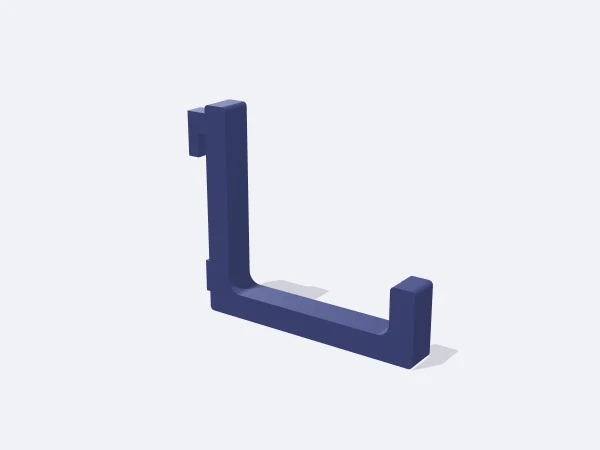
This tool builds a flat section hook for a rod, a closet rail or the top of a door to your measurements and exports it as STL. There are three types: the classic S with two opposite hooks, a closet rod hook whose top clips onto the rail, and an over-door hook that goes over the door leaf.

The top hook is 1 mm wider inside than the rod. The tip lip curls the hook end inwards and narrows the opening; the tool keeps the opening no narrower than the rod minus a small flex allowance, so the hook snaps on with a slight flex but never has to be forced. With a zero lip the opening is fully open.

Free, no sign-up. Change the sizes in millimetres and download the STL.

Flat section S-hook hanging on a round rod

Ready-made variants

Each variant is the same template with different settings. Follow the link and the editor opens with those values.

Adjustable sizes

These values are edited in the editor's template panel. A number outside the range is clamped to the nearest limit automatically.

SizeRangeDefault
Shape
Hook typeS-hook, Closet rod hook, Over-door hookS-hook
Dimensions
Rod diameter *10–40 mm25 mm
Door thickness *30–50 mm40 mm
Door gap *1.5–3 mm2 mm
Bottom opening10–60 mm30 mm
Overall length50–210 mm110 mm
Section width4–12 mm6 mm
Thickness3–16 mm6 mm
Tip lip *0–90 °30 °

Sizes marked with a star appear in the panel only when the related shape, style or option is active.

What it is used for

  • Pans, ladles and towels on a kitchen rail
  • Bags and belts on a closet rail
  • Coats and towels behind a door without drilling
  • Planters or lanterns on a balcony railing

Printing tips

Orientation
Print it lying flat: hook profile on the bed, thickness going up. The section is a flat rectangle, so layers run parallel to the hook plane.
Layer height
0.2 mm layers. The load runs inside each layer, so the hook does not split along a layer line.
Infill
The hook is thin, so use 4-5 walls; almost no infill remains and the section is solid.
Supports
Not needed. The profile is a straight prism with no overhangs.
Material
PETG or ASA is recommended; under constant load and snap fitting, PLA can slowly open up.

Tips

  • For heavy loads increase the section width, it helps more than thickness.
  • Print the over-door hook in PETG; its width is kept at 16 mm or more.

Why is the opening slightly narrower than the rod?

If the opening is wider than the rod, the hook falls off when bumped. If it is too narrow, you have to force it and the hook cracks. The tool keeps the opening at the rod diameter minus at most 8 percent (0.5 to 2 mm), so the hook opens slightly and seats.

  • Hook moved often: lip 0-15°
  • General use: lip 30°
  • Closet rod hook: top opening automatic

How do I size an over-door hook?

Measure the door leaf thickness; interior doors are usually 38-42 mm and the tool makes the inside of the U 1.5 mm wider. With the door closed, also measure the gap above it and on the frame side: the bridge and back leg are made at the door gap thickness (1.5-3 mm), so pick a value thinner than both. The hook width carries the load of the thin bridge, so it is at least 16 mm; in PETG it safely holds coats of a few kilograms.

  • Interior door: 40 mm
  • Cabinet door 18-20 mm: use the S type
  • Bottom hook for coats: 30-40 mm

Frequently asked questions

How much weight does an S-hook hold?

A PETG hook with a 6 x 6 mm section carries bags and pans of a few kilograms. For heavier loads make the section 8-10 mm wide.

Why print it lying flat?

A hook printed upright carries the load through layer adhesion and splits at the bend. Printed flat, layers run along the load and the hook is much stronger.

Why did the length grow by itself?

Both hooks need a minimum length; shorter values are extended with a note.

Similar templates

Set the sizes to fit your part

Open the template in the editor, enter your values and download a print-ready STL. No account needed.

Open in editor